How to Grow

How to Grow Lucernes Canada | Planting & Establishment

Move through the SoilCommander growing library like a course: keep the navigation in place, open the next lesson, and build your garden plan step by step.

How to Grow Lucernes Canada | Planting & Establishment guide thumbnail

Lucerne (Medicago sativa)

Alfalfa (Medicago sativa) growing in a French meadow — “Medicago sativa vallee-de-grace-amiens 80 17062007 1” by Olivier Pichard is licensed under CC BY-SA 3.0. Source: Wikimedia Commons

2 sources cited · Verified

The short answer

Site
6+ hours of sun
Biggest risk
Bacterial wilt

Lucernes (Medicago sativa) — RHS.

Unlike an annual crop, the work here is front-loaded into establishment: get the planting and the site right and the same plants crop for several seasons.

Core growing advice on this page is checked against named horticultural sources — see References.

Growth Stages

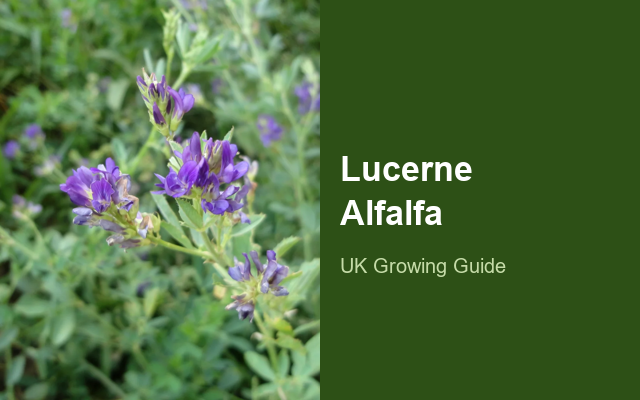
Purple alfalfa flowers on the stem — “Alfalfa (Medicago sativa) II” by Juan Carlos Fonseca Mata is licensed under CC BY-SA 4.0. Source: Wikimedia Commons
Alfalfa (Medicago sativa) II” by Juan Carlos Fonseca Mata is licensed under CC BY-SA 4.0. Source: Wikimedia Commons.
Stage BBCH Notes
Sowing 0 RHS: propagate from seed sown in autumn. PFAF instead describes a spring sowing: pre-soak seed for 12 hours in warm water, then sow in situ; seed emerges within 7-14 days. The two sources genuinely differ on season -- both are given rather than silently picking one.
Establishment (deep taproot) 3 PFAF: develops a carrot-like taproot descending 6 metres or more into the soil, giving the plant genuine drought resilience once established; growth habit is described as a "clumper with limited spread" rather than a running or invasive plant.
Flowering 6 RHS: small purple flowers appear in summer, followed by flat, pea-like fruits. PFAF: under optimal conditions the plant reaches maturity within 60-90 days of sowing.
Harvest (leaves, seed, or sprouts) 8 PFAF: harvest young leaves and shoots through the growing season; alternatively, harvest mature seed to sprout indoors year-round -- ready to eat in as little as 4-6 days from soaking.

Quick Facts

Alfalfa (Medicago sativa) growing in a French meadow — “Medicago sativa vallee-de-grace-amiens 80 17062007 1” by Olivier Pichard is licensed under CC BY-SA 3.0. Source: Wikimedia Commons
Medicago sativa vallee-de-grace-amiens 80 17062007 1” by Olivier Pichard is licensed under CC BY-SA 3.0. Source: Wikimedia Commons.
Factor Value
Sunlight 6-8 hours direct sun
Minimum survivable temp -20C
Drainage Well-drained (both sources); RHS: grows in most situations including poor, dry soil; PFAF: prefers rich, friable, loamy soil with loose topsoil and added lime, does not tolerate waterlogging.
Lifecycle RHS: a herbaceous perennial legume with a deep tap-root, rated H7 (-20C or below) -- hardy anywhere in the UK. PFAF: perennial, fast-growing, a "clumper with limited spread" thanks to a taproot that can descend 6 metres or more into the soil.
Edible parts leaves, sprouts, seeds

At a Glance

Close-up of dark purple alfalfa flowers — “Alfalfa - Trebol de España (10247116944)” by jacilluch is licensed under CC BY-SA 2.0. Source: Wikimedia Commons
Alfalfa - Trebol de España (10247116944)” by jacilluch is licensed under CC BY-SA 2.0. Source: Wikimedia Commons.
Medicago sativa Lucerne Bacterial wilt (unspeci… Leafhoppers Alfalfa weevil Spotted alfalfa aphid DISEASES PESTS

Harvest & Storage

A mature alfalfa plant — “Alfalfa-5” by Philmarin is licensed under CC BY-SA 3.0. Source: Wikimedia Commons
Alfalfa-5” by Philmarin is licensed under CC BY-SA 3.0. Source: Wikimedia Commons.

When to pick: PFAF: pick young leaves and shoots before they toughen, eaten raw, cooked, or dried for later use. For sprouts specifically: soak seed 12 hours in warm water, then keep moist in a warm place -- ready to eat in about 4-6 days.

Storage

PFAF: dry leaves/shoots for longer storage; sprouted seed is best eaten fresh soon after sprouting, following safe sprouting hygiene practices given the risk of foodborne bacteria on raw sprouts.

Diseases

A field of alfalfa in Wisconsin — “Alfalfa (Wisconsin)” by wackybadger is licensed under CC BY-SA 2.0. Source: Wikimedia Commons
Alfalfa (Wisconsin)” by wackybadger is licensed under CC BY-SA 2.0. Source: Wikimedia Commons.
Bacterial wilt (unspecified, alfalfa)

RHS: may develop bacterial wilt; no causal organism named, so kept as a generic entry rather than a fabricated one.

Pests

Close-up of alfalfa's characteristic curly seed pod — “Medicago sativa CloseUpCurlySeedPod” by SriMesh is licensed under CC BY-SA 3.0. Source: Wikimedia Commons
Medicago sativa CloseUpCurlySeedPod” by SriMesh is licensed under CC BY-SA 3.0. Source: Wikimedia Commons.
Leafhoppers

Cicadellidae (various spp.)

RHS names leafhoppers generically among the pests affecting this species.

Alfalfa weevil

Hypera postica

RHS names alfalfa weevil among the pests affecting this species.

Spotted alfalfa aphid

Therioaphis maculata

RHS names spotted aphids among the pests affecting this species.

References

  1. Habitat: waste ground, avoiding acid soils. Hardiness: USDA zones 4-11, UK zone 5, heat-tolerant zones 8-5. Soil: rich, friable, well-drained loamy soil with loose topsoil supplied with lime; mildly acid, neutral or basic, cannot grow in strongly acidic conditions. Sun: full sun, cannot grow in shade. Moisture: prefers well-drained, tolerates dry and moist, does not tolerate waterlogging. Size/habit: perennial to 1m, fast growth rate, taproot like a carrot descending 6m or more, "clumper with limited spread". Propagation: pre-soak seed 12 hours in warm water, then sow in spring in situ; emerges in 7-14 days, matures in 60-90 days under optimal conditions. Edible use: leaves/shoots raw or cooked or dried, very rich in vitamins A, B and C; sprouted seed (pre-soak 12 hours, then keep moist and warm, ready in 4-6 days); ground seed mixed with cereal flours for nutritionally improved bread. Medicinal use: antiscorbutic, aperient, diuretic, haemostatic, nutritive, stimulant, tonic; nutritive tonic to stimulate appetite; vitamin K aids blood clotting; used for asthma, diabetes, gastrointestinal disorders. Safety: contains saponin-like substances, large quantities may cause red blood cell breakdown; sprouts contain canavanine, ingestion can cause recurrence of systemic lupus erythematosus; avoid during pregnancy/lactation and for people with gout; may interfere with warfarin and corticosteroids. Also: a good bee plant and a food plant for many caterpillars. No specific pest/disease information given.

  2. Hardiness H7 (-20C or below), survives severe European continental climates. Soil: chalk, clay, loam, sand; grows in most situations including poor, dry soil. Position: full sun to partial shade, east/north/south/west-facing. Exposure: exposed or sheltered. Size: height/spread 0.5-1m, 1-2 years to maturity. Moisture: moist but well-drained or well-drained. pH: acid, alkaline or neutral. Propagation: from seed sown in autumn. Pests: alfalfa weevil, leafhoppers, spotted aphids. Diseases: may develop bacterial wilt. Garden use: recommended for wildflower meadows and wildlife gardens; improves soil nutrient levels and reduces compaction. Description: deep tap-root, clover-like green foliage, small purple flowers in summer followed by flat pea-like fruits; traditionally used as animal feed and green crop.

2 independent sources are cited for this crop. Where they disagree - soil pH is the clearest case - every figure is preserved rather than averaged into false precision.

Frequently Asked Questions

What problems affect lucernes?

Our data links 1 disease and 3 pests to this crop. See the sections above for each one and how to manage it.

Plan next season before the problems start

Short-season growing is arithmetic before it is technique: days to maturity against frost-free days decides what will finish at all. The Canada Garden Planner does that subtraction for your region before you sow.

Get the Canada Garden Planner →

Instant PDF download · Written for Canadian growing conditions

SoilCommander Editorial Team

Canadian vegetable growing guides · Adapted for Canadian hardiness zones and frost dates

Every SoilCommander guide is written and maintained by our editorial team for real Canadian growing conditions, adapted to Canadian hardiness zones and frost-date data, with provincial agriculture and Canadian university extension guidance cited directly where a crop-specific source exists.

Vegetable Growing Guides Canada

Last verified 2026-09-05

Relevant next steps

Where To Go From Here

Take this crop from reading into a written plan for your own beds.

Free Tool
soilcommander.com/pages/garden-planner
1 · Shape
2 · Crops
3 · Conditions
4 · Plan
Choose your garden shape
🍅
Bed 1
Tomatoes
🍌
Bed 2
Legumes
🥦
Bed 3
Brassicas
🥕
Bed 4
Roots
🥥
Bed 5
Alliums
🌿
Herbs & More

Free planning tool

Plan your veg garden before you dig a single inch

Sketch your exact plot shape, pick your crops, and get a spacing-accurate bed layout with companion pairings and a rotation plan. Spacing, companion pairings and rotation work the same in any climate — pair the layout it gives you with the Canada planting calendar for your own frost-date timing.

Garden Layout Planner Tool

Free to use. Nothing to install.

Plan the next step

Use the printable SoilCommander planner for your region to turn this guide into sowing dates, bed layouts and weekly garden tasks.

Get Planner