
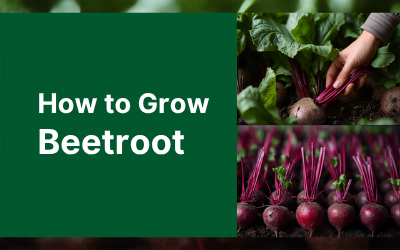
Beetroot (Beta vulgaris)

6 sources cited · Verified
The short answer
- Plant
- Late February to late July
- Ready in
- 40–80 days
- Site
- 4+ hours of sun, soil pH 6–6.8
- Biggest risk
- Downy mildew
In the UK, beetroot go in the ground late February to late July, and are ready to harvest 40–80 days after planting.
Beetroot (Beta vulgaris) — biennial (requires two growing seasons, but treated as an annual).
This crop carries an unusually heavy problem load: 2 diseases, 5 pests and 0 nutrient issues are documented for it, so most of the effort in growing it well goes into prevention.
Core growing advice on this page is checked against named horticultural and university-extension sources — see References.
Watch: Growing Beetroot at Home
A quick SoilCommander video on growing beetroot at home in UK conditions — sowing, spacing, care and harvest in under a minute.
Diseases
Pests
Quick Facts
| Factor | Value |
|---|---|
| Soil pH | 6 - 6.8 |
| Sunlight | 4-6 hours direct sun |
| Germination temp | 7C |
| Optimal growing temp | 15.6-18.3C |
| Minimum survivable temp | -6C |
| Time to harvest | 40-80 days |
| Soil texture | RHS: "Fertile soil that drains well and doesn't become waterlogged". |
| Drainage | RHS: drains well, in a sunny site. Utah State: "Prefer sunny locations". |
| Lifecycle | biennial (requires two growing seasons, but treated as an annual) |
| Edible parts | roots, leaves |
At a Glance
Regional Planting Calendar
| Region | Sow |
|---|---|
| Southern England | late February to late July |
| Midlands derived | early March to late July |
| Northern England | early April to late July |
| Scotland | early April to late July |
Rows marked derived are interpolated between regions our sources do state, because no source we consulted gives a figure for that region specifically. They are deliberately wider to reflect that uncertainty.
Southern England - detail & sources
RHS: sow outdoors from late March or April through to July once soil reaches 7C; earlier sowings from late February are possible with a bolt-resistant variety under fleece or cloches. Southern England has the UK's earliest soil-warming and last-frost dates per Met Office, so the earliest end of the cloche-sowing window applies here.
Midlands - detail & sources
DERIVED: interpolated about a week later than southern England for the earliest cloche-protected sowing, following RHS's late-Feb-to-July sowing method and the Met Office's documented south-to-north soil-warming/frost gradient. The July sowing-end date is UK-wide per RHS and not adjusted.
Northern England - detail & sources
RHS: sow outdoors from late March or April through to July once soil reaches 7C. Met Office notes the average last air frost and soil-warming extend later further north, so early cloche sowing is less reliable here -- the standard April start is used rather than the southern cloche-earliest date.
Scotland - detail & sources
RHS: sow outdoors from late March or April through to July once soil reaches 7C. Scotland gets the UK's latest soil-warming and last-frost dates per Met Office, so the April start (rather than the southern late-February cloche option) is the realistic earliest sowing here.
Soil & Growing Conditions

Growth Stages
| Stage | BBCH | Notes |
|---|---|---|
| Sowing & germination | 0 | Beetroot is sown direct where it is to grow - from March under cloches or fleece, and from April to July outdoors, once the soil has warmed to about 7C. Sow seeds around 2.5cm (1in) deep in rows roughly 30cm apart, watering the drill in dry weather. Because each knobbly seed is really a cluster of several seeds, seedlings usually emerge in small clumps that will need thinning. Seed germinates in about two weeks. Sow a short row every 2-3 weeks for a continuous succession of tender roots. |
| Thinning & leaf growth | 3 | Once seedlings are large enough to handle, thin the clumps to leave one plant about every 10cm for full-sized roots (thin to around 4-5cm for smaller baby beets); RHS thins to 10cm and Univ. of Maryland to 3-4in. Keep the rows weed-free and water regularly while plants are young. Steady, even moisture matters from now on - RHS advises watering about every 10-14 days in dry spells and avoiding irregular watering, which makes roots split or turn woody. Thinnings can be eaten as leafy salad greens. |
| Root swelling | 4 | The base of the stem swells into the familiar round or cylindrical root. Keep watering even and regular - a dry spell followed by heavy watering causes roots to crack, while prolonged drought makes them woody. Little extra feeding is needed on fertile soil; avoid high-nitrogen feeds, which push leaf growth at the expense of the root. Continue to keep the bed weed-free so the swelling roots are not competing for water and light. |
| Maturity & harvest | 8 | Beetroot is ready roughly 40-80 days after sowing. Pull roots young for the best flavour and texture - RHS suggests golf-ball size for baby beets and no larger than a cricket ball when mature; Univ. of Maryland harvests at 1-3in diameter. Ease roots out with a fork and twist off the leaves about 2.5cm above the crown (do not cut, to avoid bleeding). Use fresh, or store in a cool shed or the fridge; Utah State and Univ. of Maryland keep roots at about 0C (32F) and 95% humidity for two to four months. |
Harvest & Storage

Recommended Varieties
Beetroot 'seed' is actually a dried fruit cluster of 2-4 true seeds fused together, so even a single sowing station usually needs thinning -- unless you choose a monogerm variety bred to produce one seedling per seed.
- Boltardy — the most widely grown UK variety; strong bolt resistance makes it the safest choice for an early sowing, with deep red, sweet flesh.
- Pablo F1 — a monogerm variety producing one seedling per seed, so no thinning is needed; uniform, smooth roots with good bolt resistance.
- Cylindra — long, cylindrical roots that slice into even rounds; needs deeper soil than round varieties but gives a high yield per row.
- Burpees Golden — golden-orange flesh that doesn't bleed onto other ingredients when cut, with a milder, sweeter flavour than red varieties.
Storing Beetroot Through Winter
Lift roots before hard frosts, typically October–November. Twist off the foliage rather than cutting it (cutting causes the root to "bleed") and let the roots dry for a day before storing. Pack into boxes of slightly damp sand and keep somewhere cool and frost-free -- a shed or garage works well, and roots stored this way keep for around 2–4 months.
Recommended Tools & Supplies
Having the right tools makes growing beetroot easier. Our hand tools for gardening include hoes for keeping rows weed-free while roots establish, and the soil and plant care range covers mulches for retaining the even moisture beetroot needs to avoid splitting.
Planning the wider plot? See the UK vegetable planting calendar.
Beetroot Varieties and Pest Watch


References
-
Tier 1. Primary UK source for sowing timing, depth, thinning/spacing, watering, harvest size and storage.
-
Tier 1. US extension corroboration for sowing depth, thinning, moisture and harvest diameter.
-
Tier 1. US extension corroboration for siting, watering and cold storage.
-
Tier 1. US extension corroboration for culture of root crops including beet.
-
Tier 1. International agronomic ranges (temperature, pH).
-
Tier 1. Taxonomic backbone reference.
6 independent sources are cited for this crop. Where they disagree - soil pH is the clearest case - every figure is preserved rather than averaged into false precision.
Frequently Asked Questions
When should I sow beetroot in the UK?
In southern England, from late February. In northern England and Scotland, wait until early April. Treat these as a guide rather than a fixed date — the governing rule is to sow only once frost risk has passed and temperatures are reliably warm enough.
When do I sow beetroot?
Sow late February to late July, at around 7°C for germination.
How long do beetroot take to grow?
Typically 40–80 days, depending on cultivar and growing conditions.
What soil pH do beetroot need?
A pH of about 6–6.8. That span reflects genuine variation between the authorities we cite rather than a single agreed figure — the References section lists each source's exact range.
What problems affect beetroot?
Our data links 2 diseases and 5 pests to this crop. See the sections above for each one and how to manage it.
Plan next season before the problems start
Most of the advice on this page comes down to timing and spacing — sowing at the right moment, rotating beds, and giving plants enough airflow. The UK Garden Planner lays your plot out month by month so those decisions are already made before the season starts.
Get the UK Garden Planner →Instant PDF download · Written for UK growing conditions
Last verified 2026-07-31
Tools That Help With This Crop
Use these links when the guide moves from reading into sowing, planting, watering, and keeping the crop healthy.
Plan the next step
Use the printable UK Vegetable Garden Planner to turn this guide into sowing dates, bed layouts, and weekly garden tasks.